
Salvage explained / Auction markings
Copart UK windscreen codes explained
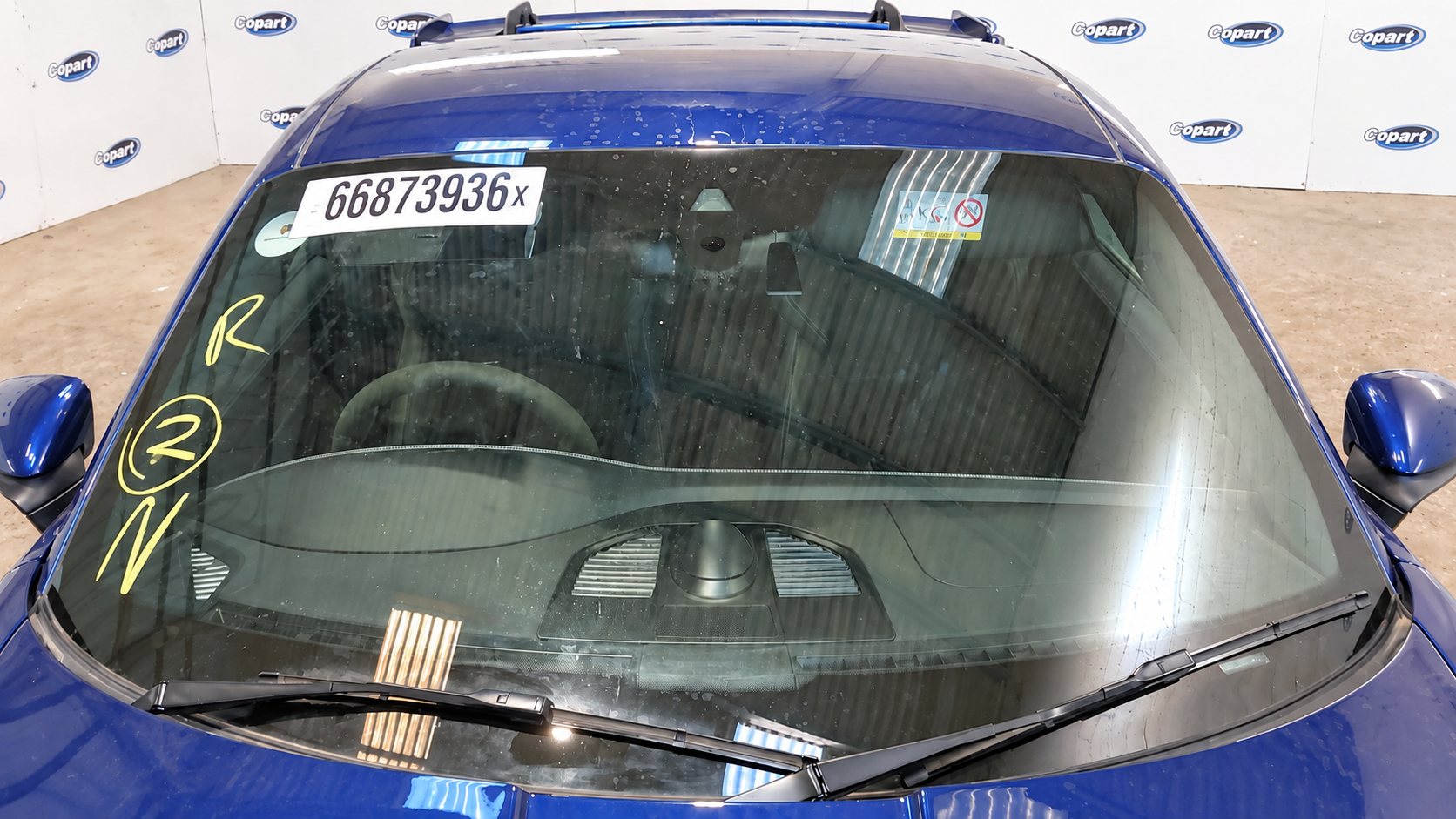
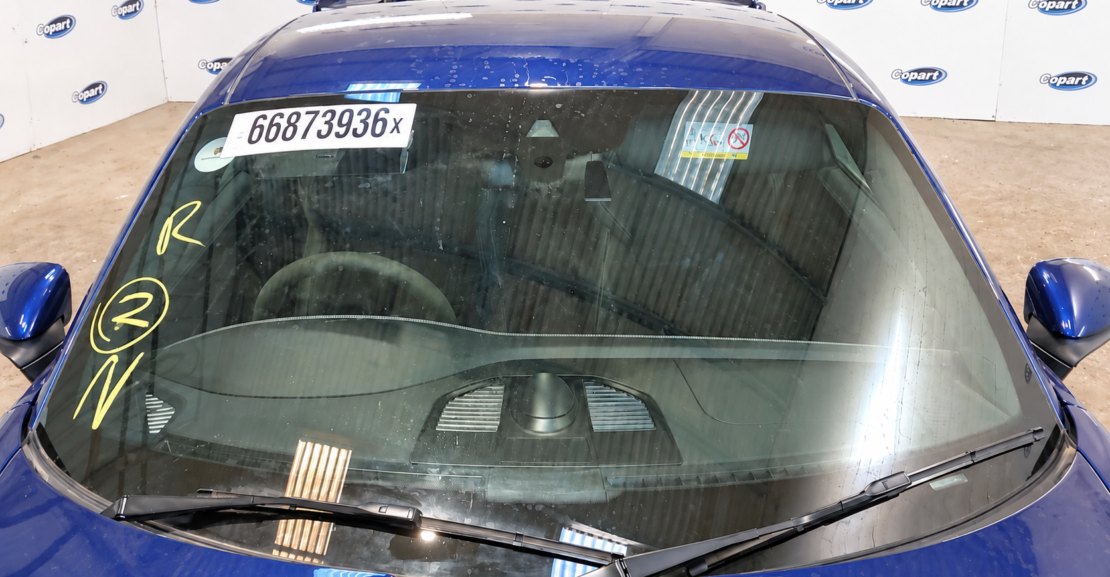
There are two different sets of markings on a Copart windscreen. The letter printed after the lot number appears to identify the vehicle’s source or processing route. The handwritten paint-pen marks record what happened when the vehicle was received and checked.
Printed sticker: C is strongly associated with consumer, private or smaller-trade entries; Q with commercial, finance-company or Copart-linked sources. P and X both appear to identify vehicles entered directly by insurers. They do not mean “high value” and “low value”.
Paint pen: R = received, N = nothing, S = starts, D = drives, while a circled number normally records the number of keys.
What the Copart windscreen codes really mean
There are two separate systems. The small letter printed after the lot number is a sticker suffix. Letters and circled numbers written directly on the glass are paint-pen yard marks. They should never be read as one combined code.
Printed sticker suffixes
| Suffix | Best-supported meaning | What we can say with confidence |
|---|---|---|
| C | Consumer, private or smaller-trade entry route | Often accompanied by detailed seller-supplied notes. A strong source clue, although not proof that every C vehicle is privately owned. |
| Q | Commercial, finance-company or Copart-linked source route | Found on vehicles from CashForCars and Close Brothers Motor Finance. It is broader than simply “owned by Copart”. |
| P | Direct-from-insurer auction entry | P consistently appeared on insurer-sourced vehicles. It does not mean “high value”. |
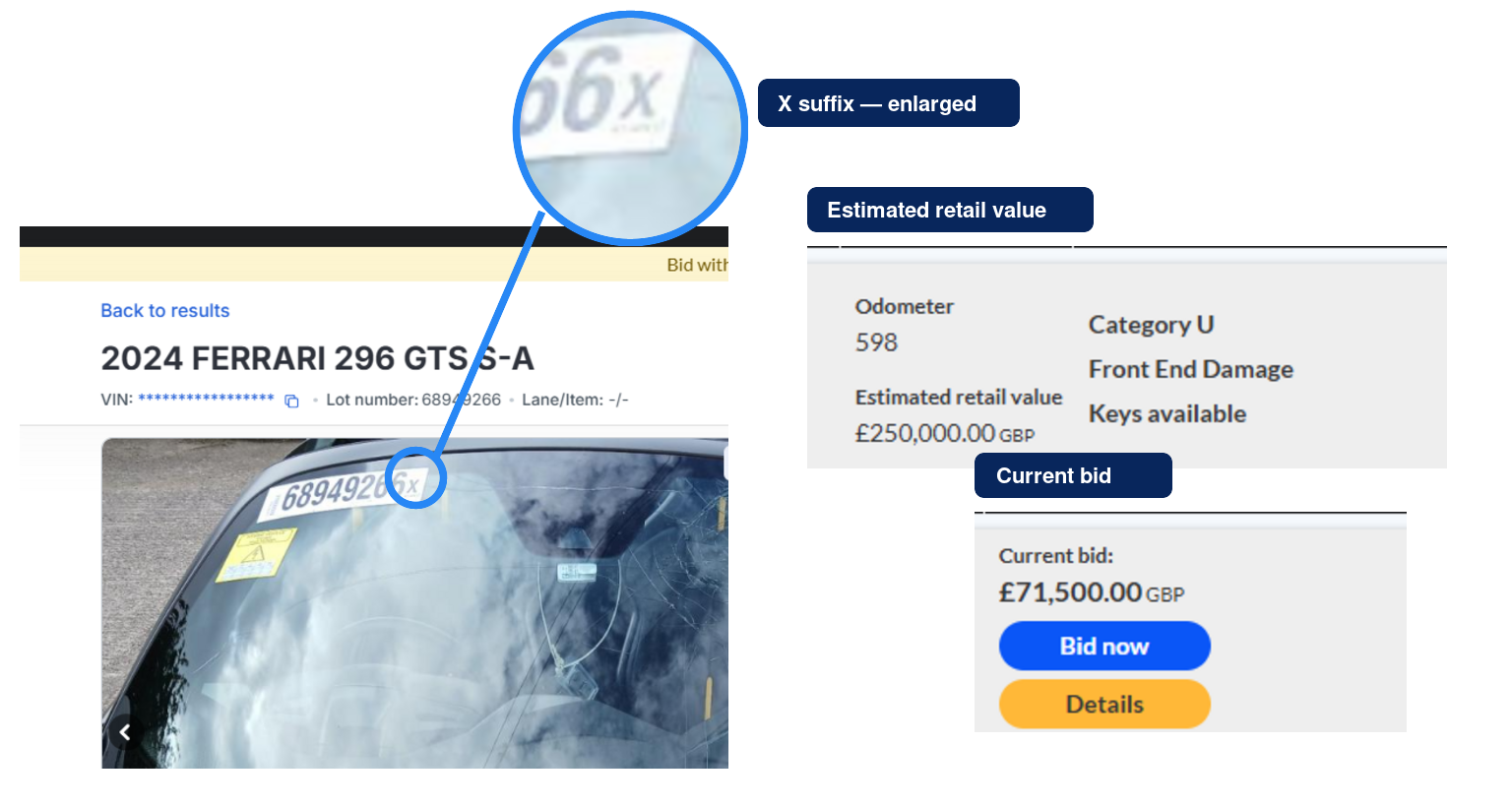
| X | Direct-from-insurer auction entry | X also appeared on insurer-sourced vehicles. It does not mean “low value”; one example was a £250,000 Ferrari. |
Copart does not publish a complete public key for these suffixes. In our sample, P and X both appeared to identify vehicles entered directly by insurers. What distinguishes P from X remains unconfirmed.
Handwritten paint-pen markings
| Mark | Best-supported meaning | What it tells you |
|---|---|---|
| R | Received | The vehicle entered the yard process. It does not mean the engine runs. |
| N | Nothing | The car did not even start when checked. It does not mean Category N. |
| S | Starts | The engine started and ran at idle, but the vehicle was not confirmed as driving. |
| D | Drives | The vehicle could be put into gear and was capable of moving forwards under its own power. |
| Circled 0, 1 or 2 | Keys recorded | The number of keys noted during processing. |
These handwritten marks are operational yard notes—not sticker suffixes, insurance categories or valuations.
How we put the myths to bed
We manually reviewed close to 100 Copart UK vehicles. For each one, we compared the printed sticker suffix and handwritten paint-pen marks separately against the seller, category, run condition, damage, key count, value and photographs. We deliberately searched for vehicles that would disprove the popular explanations.
The best-known sticker theory claims that X means low value, P means high value, Q means purchased by Copart and C means private entry. It can be traced to a PistonHeads comment posted on 19 October 2023. The same username reposted it on Scirocco Central later that day, introducing it as “mainly my opinion”. That qualification disappeared as the list was copied elsewhere.
That poster was discussing the printed sticker suffixes, not the handwritten paint-pen markings. We tested those sticker claims against actual vehicle values and sellers. Separately, we tested the common paint-pen assumptions—such as R meaning “runs” and N meaning “Category N”—against the vehicles’ recorded categories and run conditions.
Myth: X means low value and P means high value
Our checks show that this value theory is wrong. The X-suffix 2024 Ferrari below had an estimated retail value of £250,000 and a current bid of £71,500.
The P-suffix Subaru was a Category S non-runner with engine fire damage and an estimated retail value of £27,500.
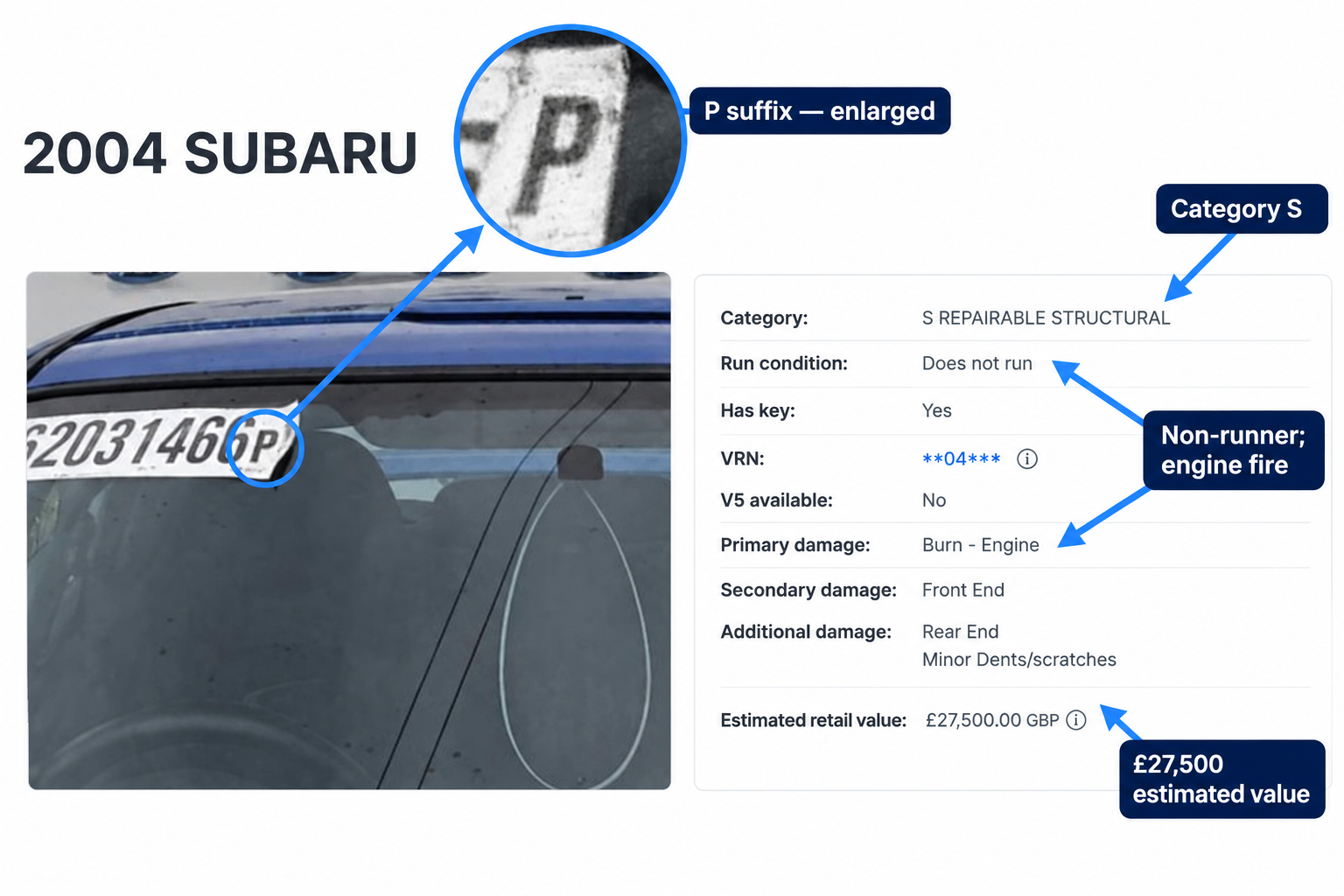
What P and X have in common is more useful than the invented value distinction: both appear to mark vehicles entered directly by insurers. The evidence does not yet tell us what separates a P entry from an X entry.
Copart also uses Category X for stolen-recovered vehicles with minimal damage. That category appears separately in the listing. An X printed after the lot number is not automatically the same thing; the Ferrari above was listed as Category U.
Myth: C always means private and Q means Copart-owned
C repeatedly appeared on consumer, private or smaller-trade entries, often alongside detailed “seller advises” notes. The Porsche below is a useful example: its printed lot label ends in C and the listing includes unusually specific information supplied by the seller.
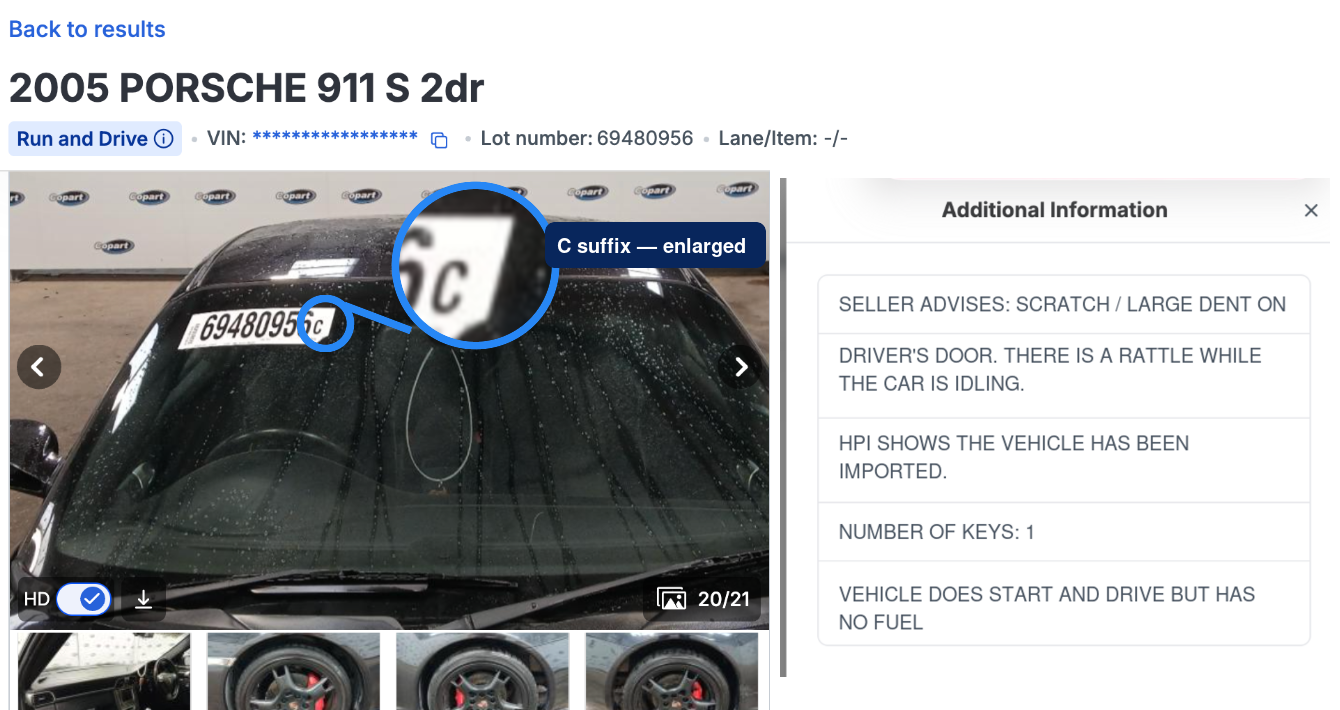
This supports C as a consumer, private or smaller-trade entry route. It remains a strong pattern rather than a published Copart definition.
Q appeared on company-sourced vehicles. The BMW below displayed CashForCars as the seller; CashForCars describes itself as part of Copart and says it buys cars directly from customers for resale through online auctions. We also found Q on a Close Brothers Motor Finance vehicle.
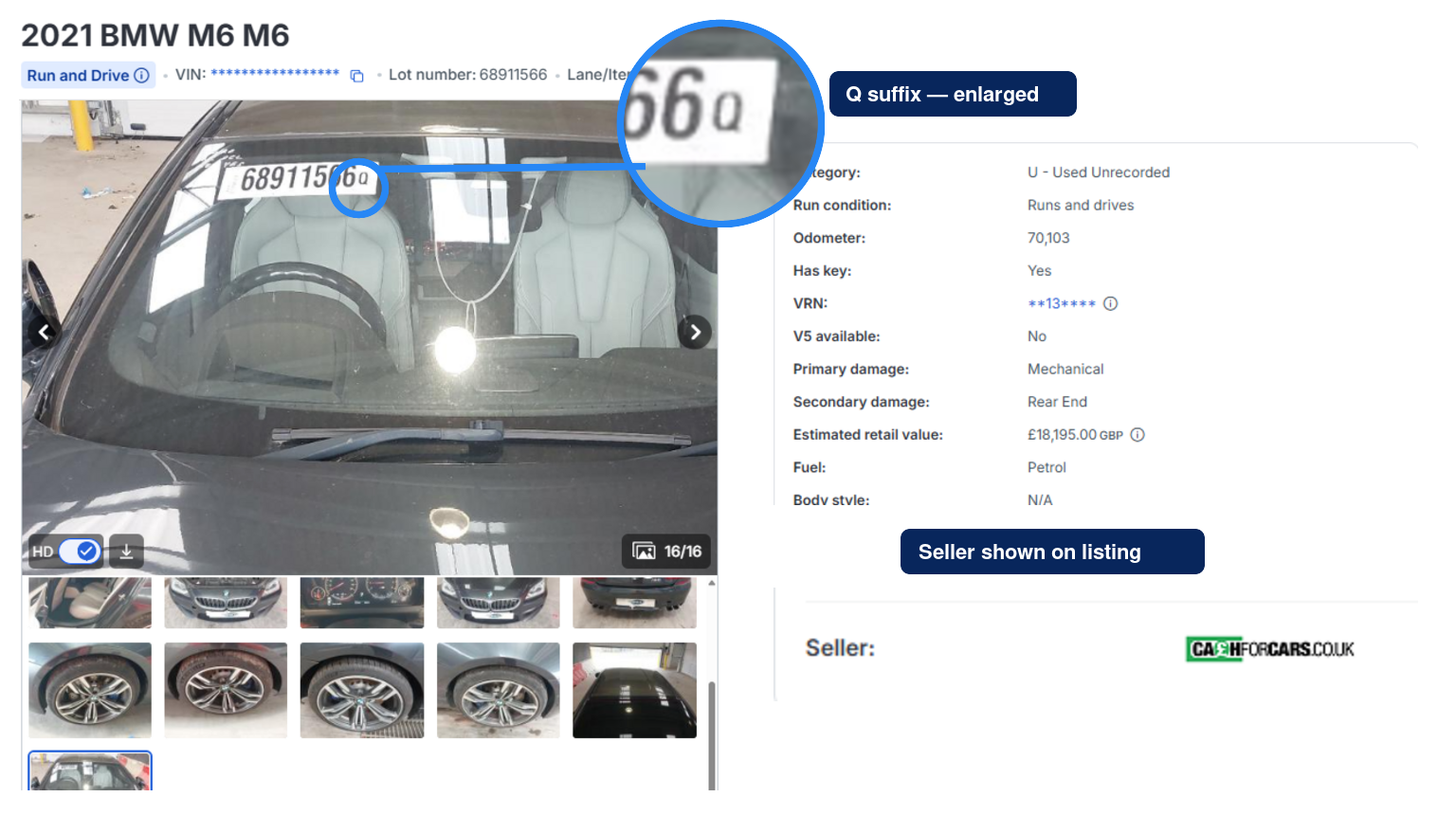
That makes “Copart purchased it” too narrow. The evidence points more broadly to a commercial, finance-company or Copart-linked supply channel.
Myth: N means Category N and R means runs
N is commonly mistaken for Category N. Our sample disproved that. The Volkswagen ID.4 below was listed as Category S and does not run, yet an N is clearly written on its windscreen.
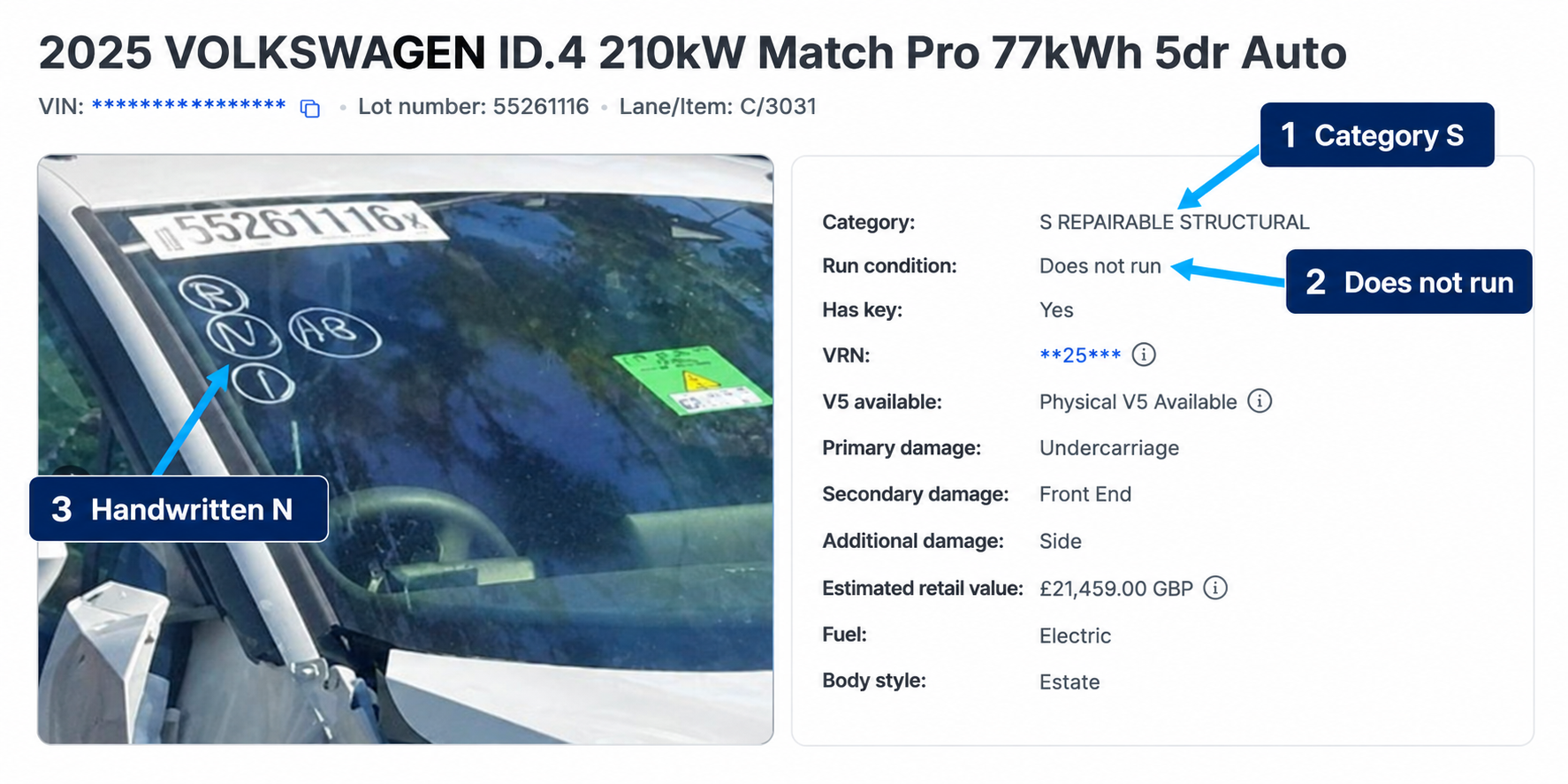
The practical reading is “nothing”: the vehicle did not even start when checked. Its formal write-off category appears separately in the listing.
R is just as often misread as “runs”. We found it on running vehicles and confirmed non-runners, including vehicles with severe engine-bay fire damage. The best-supported meaning is received: the car entered the yard process. It is not evidence that the engine ran.
For mechanical status, use the listing’s Engine Start or Run and Drive information—not an R on the glass.
The S and D pattern was much clearer. Every vehicle in our sample listed under Copart’s Engine Start Programme carried an S on the windscreen. Every vehicle we checked that was listed as Run and Drive carried a D.
That matches Copart’s own definitions: Engine Start means the vehicle “started, and ran at idle”; Run and Drive means it started, could be put into gear and was capable of moving forwards under its own power. Neither status guarantees what the vehicle will do later.
What remains unconfirmed?
We could not establish reliable meanings for ICE, CW, PB, RB or JB. Some two-letter paint-pen marks appeared on stolen-recovered vehicles, but not consistently enough to publish a decoder. Photograph count was also unreliable and did not establish the meanings of the printed suffixes.
The “Enhanced Vehicle” E icon shown on the website is another separate designation. Copart says it indicates that the seller authorised possible preparation such as washing, vacuuming or protective covering. It is neither a printed lot-number suffix nor a paint-pen code.
The most important rule is to identify which system you are looking at. Read the printed suffix as a source or processing clue; read paint-pen letters as yard checks; and rely on the actual listing for category, condition, seller and damage.
This investigation records patterns visible in a sample of close to 100 Copart UK listings in September 2026. Copart does not publish a complete public key and processes can change. If you have worked in Copart vehicle processing and can document a code, send us the photograph and listing details; we will update this guide when the evidence supports it.