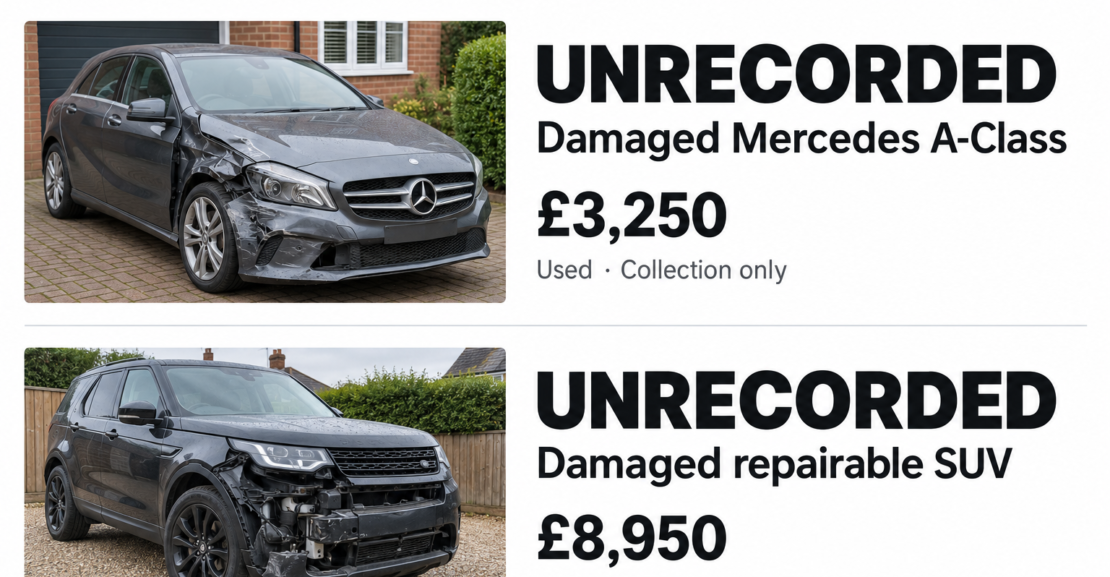
Salvage explained / Vehicle history
Why are some damaged cars advertised as “unrecorded”?
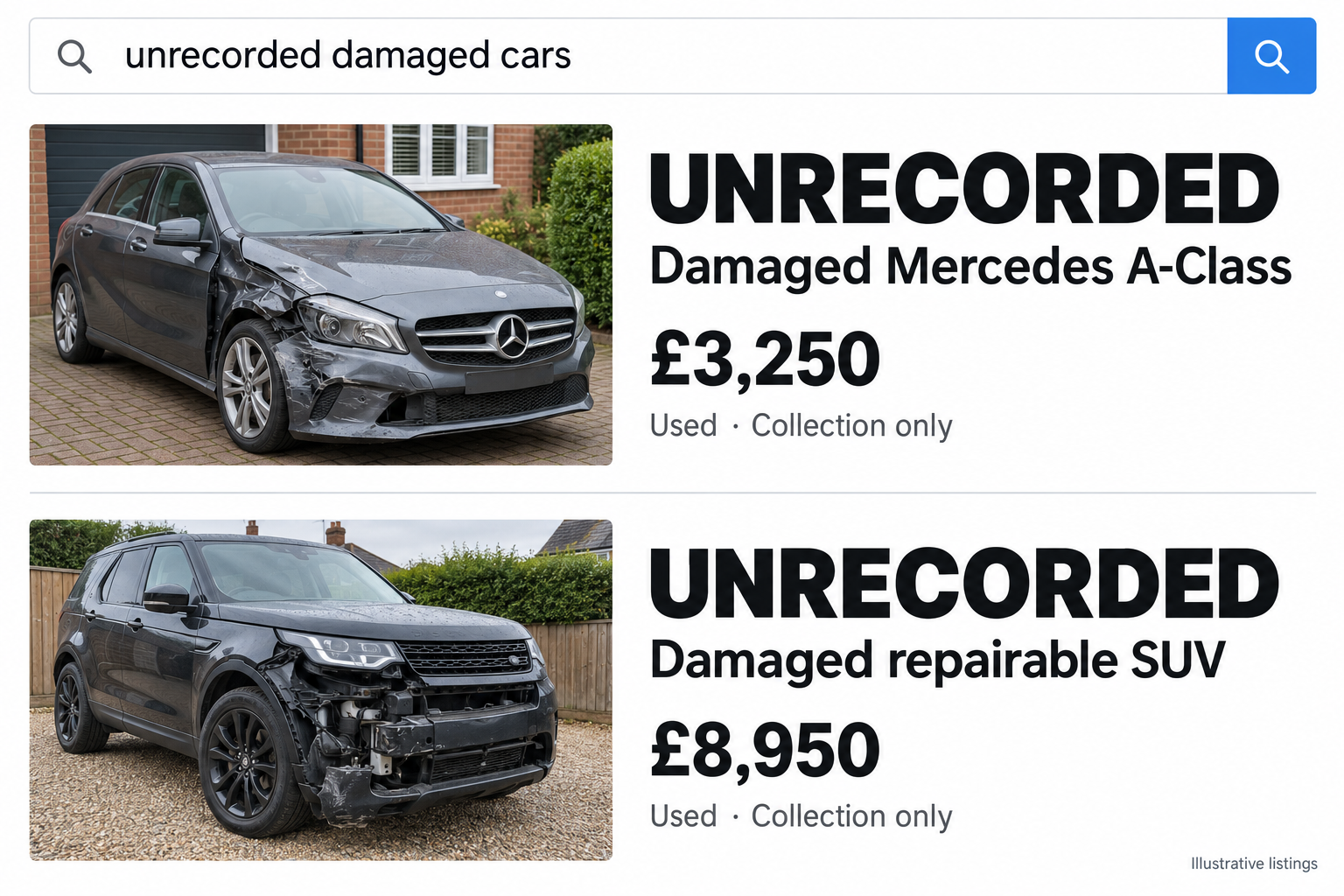
A clear write-off check does not tell the whole story. Why damaged cars can be unrecorded, and how salvage auction history can reveal more.
“Unrecorded” does not mean undamaged. A car may have had no insurance payout, an owner may never have claimed, or its write-off record may be missing or delayed. Check auction history as well as the current category marker.
Why can a damaged car be unrecorded?
You will see adverts with “UNRECORDED”, “non-recorded” or “HPI clear” in the title, even when the photographs show obvious damage. There are several possible explanations:
- The owner did not claim. They may have paid for repairs themselves or sold the damaged car instead.
- There was no cover for the damage, or the insurer declined the claim. Examples can include an uninsured driver, a track-day accident without suitable cover, or a drink-driving exclusion affecting damage to the driver’s own car. The outcome depends on the policy and circumstances.
- The record is missing or incomplete. A write-off may not have been reported correctly, or an update may not yet have reached the database being checked.
Copart explains that some severely damaged uncategorised vehicles have had no insurance claim, including cases involving uninsured drivers. No payout does not, by itself, guarantee that a vehicle will remain unrecorded.
A clear check is not a clean history
A report showing no write-off marker tells you what that check found at that time. It does not prove the car has never been crashed, repaired or previously described as a write-off at auction.
A vehicle may have an auction listing showing Cat S or Cat N while a separate history report shows no recorded write-off. That discrepancy needs investigating. The clear result does not erase the auction history.
Likewise, “HPI clear” in an advert is a seller’s claim: ask to see the actual dated report and who supplied it. Do not assume the phrase means an HPI-branded check was carried out, or that every provider searches the same additional sources.
Look for salvage auction history and photographs
Total Car Check is a useful option because it includes a salvage-history check separately from the insurance write-off check. Its sample report shows these as separate entries.
Where available, auction-history information and photographs can reveal how a vehicle looked before repair and the category under which it was advertised. Look for previous listings from salvage auctions such as Copart, rather than stopping at the report’s write-off result.
If an earlier auction entry says Cat S but the current check is clear, ask the seller and report provider to explain it. Treat the auction category as evidence of how the car was listed, rather than guessing what category it “should” have from a photograph.
Coverage and photographs depend on the records available; not every auction appearance will be found. An empty salvage-history result is not proof that a car has never been damaged. Check Total Car Check’s current packages and prices before paying, and make sure your chosen check includes the information you need.
Could a write-off marker appear later?
Yes. Reporting delays and administrative errors can leave a marker absent from an earlier check. A later update or correction may change the result. Start Rescue discusses these gaps in reporting.
Even if the marker never appears, a future buyer or part-exchange dealer may uncover auction photographs and reassess the car’s value. Paying a “clear history” price without checking further can therefore leave you out of pocket when you sell.
What should buyers and sellers do?
Before paying, run your own current history check, look at the salvage-history section and ask about any previous damage, auction sale or insurance claim. Match the registration and VIN to the car, and have the actual condition and repairs inspected. Save the advert and dated reports.
“Cat U” is an auction or trade description for an uncategorised vehicle, not an extra damage grade alongside A, B, S and N. It does not mean minor damage.
When selling, describe the history you know, including a previous auction category, even if a current report shows no marker. Give buyers both facts rather than using “HPI clear” to suggest the car has never been damaged or written off.
UK guidance checked on 18/09/2026. History checks reflect available data; insurance cover and reporting depend on the individual circumstances.